
 By
By If you’ve ever wrestled a pile of tangled tie-downs in the back of a truck, you already understand the appeal of retractable ratchet straps. They’re designed to do the same job as traditional ratchet straps—secure cargo during transport—but with a built-in retraction system that keeps the webbing neat, compact, and quick to deploy.
Below is a practical, no-fluff guide to choosing the right retractable ratchet straps, using them correctly, and avoiding the most common mistakes.
What are retractable ratchet straps?
Retractable ratchet straps are tie-down straps with a ratcheting handle and an internal spring-loaded (or self-winding) mechanism that automatically reels the webbing back in when you release it. Think “seatbelt,” but built for cargo.

Why people like them:
- Faster setup and teardown (less rolling and tying off)
- Less tangling in storage
- Cleaner, more consistent strap management
What they don’t do:
- They don’t automatically make your load “safe” without proper anchor points and technique
- They’re not always the best choice for every load (more on that below)
When retractable ratchet straps are a great choice
Retractable ratchet straps shine for everyday hauling like:
- Furniture and appliances
- Coolers, totes, and camping gear
- ATVs/UTVs (depending on tie-down method)
- Lumber bundles (when protected from sharp edges)
- General cargo on utility trailers and in truck beds
They’re especially handy when you’re loading/unloading often (job sites, weekend projects, frequent renters).
When you shouldn’t use retractable ratchet straps
Even good gear has limits. Skip retractable ratchet straps (or switch to a different securement method) when:
- You’re securing a vehicle by the wheels/tires (car haulers often do better with wheel nets, axle straps, or dedicated vehicle tie-down kits).
- Your load has sharp edges (metal corners, raw lumber edges, scrap) unless you use edge protectors.
- You need extra-long runs (some retractables are shorter than standard 27–30′ straps).
- You need maximum tension control for heavy equipment—traditional long-handle ratchets may give you more leverage and flexibility.
How to choose retractable ratchet straps (the checklist)
1) Check the ratings: WLL vs break strength
You’ll usually see two numbers:
- Working Load Limit (WLL): the safe limit for everyday use
- Break strength: the strap’s failure point (much higher than WLL)
Always shop and load-plan around WLL, not break strength.
2) Pick the right width
Common sizes:
- 1″ straps: lighter-duty, smaller cargo
- 1.5″ straps: versatile “middle ground”
- 2″ straps: most common for heavier cargo and trailers
3) Choose the right end fittings
Make sure the hooks match your anchor points:
- S-hooks (often with safety clips)
- J-hooks
- Flat hooks
- Carabiner-style hooks (varies by model)
If your trailer has D-rings, stake pockets, or E-track, pick hardware that seats securely without twisting.
4) Confirm length (and be realistic)
Retractables often trade length for convenience. If you routinely strap over tall loads or wide items, measure your typical “wrap” distance first.
5) Consider the mechanism quality
A smooth retraction system matters. Cheaper retractables can retract weakly, jam, or wear faster—especially if you’re in dirt/sand often.
How to use retractable ratchet straps safely (step-by-step)
- Inspect first (every time)
Look for fraying, cuts, melted spots, stitching damage, bent hooks, or a ratchet that feels gritty or skips. - Set your anchor points
Use strong, rated points: D-rings, frame-mounted tie-downs, trailer-mounted anchors, E-track, etc. Avoid weak rails or anything that can bend. - Lay the strap flat
No twists. Twisted webbing reduces strength and can loosen more easily. - Position the strap for downward force
You want the strap to press the load down and in, not just sideways. For tall items, use two straps at different heights if needed. - Tighten until snug—don’t over-crank
Ratchets can generate a lot of force. Over-tightening can:
- crush cargo (drywall, furniture, plastic totes)
- bend anchor points
- damage the strap
- Tie down the “movement directions”
Think: forward/back, side-to-side, and up/down. A good rule is at least two straps for most trailer loads, more for long or heavy items. - Do a short test + re-check
After 5–10 minutes of driving (or the first few turns/brakes), pull over and re-check tension. Loads settle.
Common mistakes to avoid
- Hooking to something not meant for tie-downs (thin rails, decorative loops, weak stake sides)
- Strapping over sharp edges without protectors
- Using one strap for a load that needs two (or four)
- Letting the strap rub on a tire, hot exhaust, or moving suspension
- Assuming “tight” equals “secure” without checking load movement and anchor strength
Care and storage tips (to make them last)
- Keep retractables clean and dry (water + grit is a ratchet’s worst friend).
- Don’t store them under heavy objects that can deform the mechanism.
- If the strap gets wet, extend it and let it dry before long-term storage.
- Retire straps that show serious fraying, cuts, chemical damage, or heat glazing.
FAQ: retractable ratchet straps
Are retractable ratchet straps as strong as regular ratchet straps?
Some are comparable, but it depends on the model. Always compare WLL and hardware quality, not just “2,000 lb” marketing language.
Can I use retractable ratchet straps for motorcycles?
Sometimes, yes—if the anchor points and strap angles are correct and you’re using proper soft loops/handlebar or triple-tree methods. Many riders still prefer traditional straps for better length and control.
Do I still need to stop and re-check them?
Yes. Any load can settle. A quick re-check is cheap insurance.
There is still time to enter our towlos giveaway!

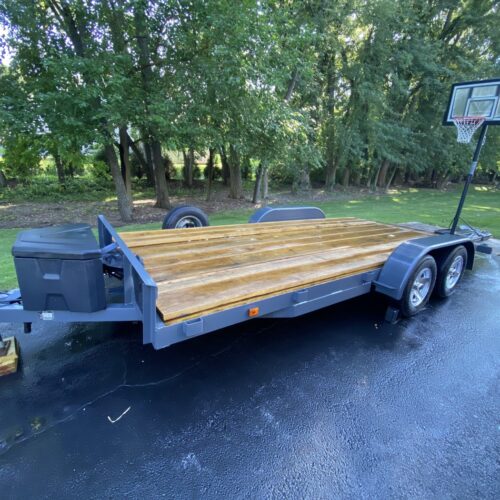
There’s also still time to enter the towlos giveaway! If you’ve been thinking about upgrading your setup, this is your sign—our grand prize is a 20-foot, 10K car hauler, and every trailer you upload to towlos counts as an entry. Get your trailer listed, spread the word, and you could be hauling in style sooner than you think. Happy towing.